Slay the Spire Leads a Year of Board Games, Quick Plays and New Favorites
Story by craftymacaron · 917 readers
Slay the Spire logged 37 hours, while Cascadia and Flamecraft won personal honors. Here’s what the group played and hopes to try in 2026.
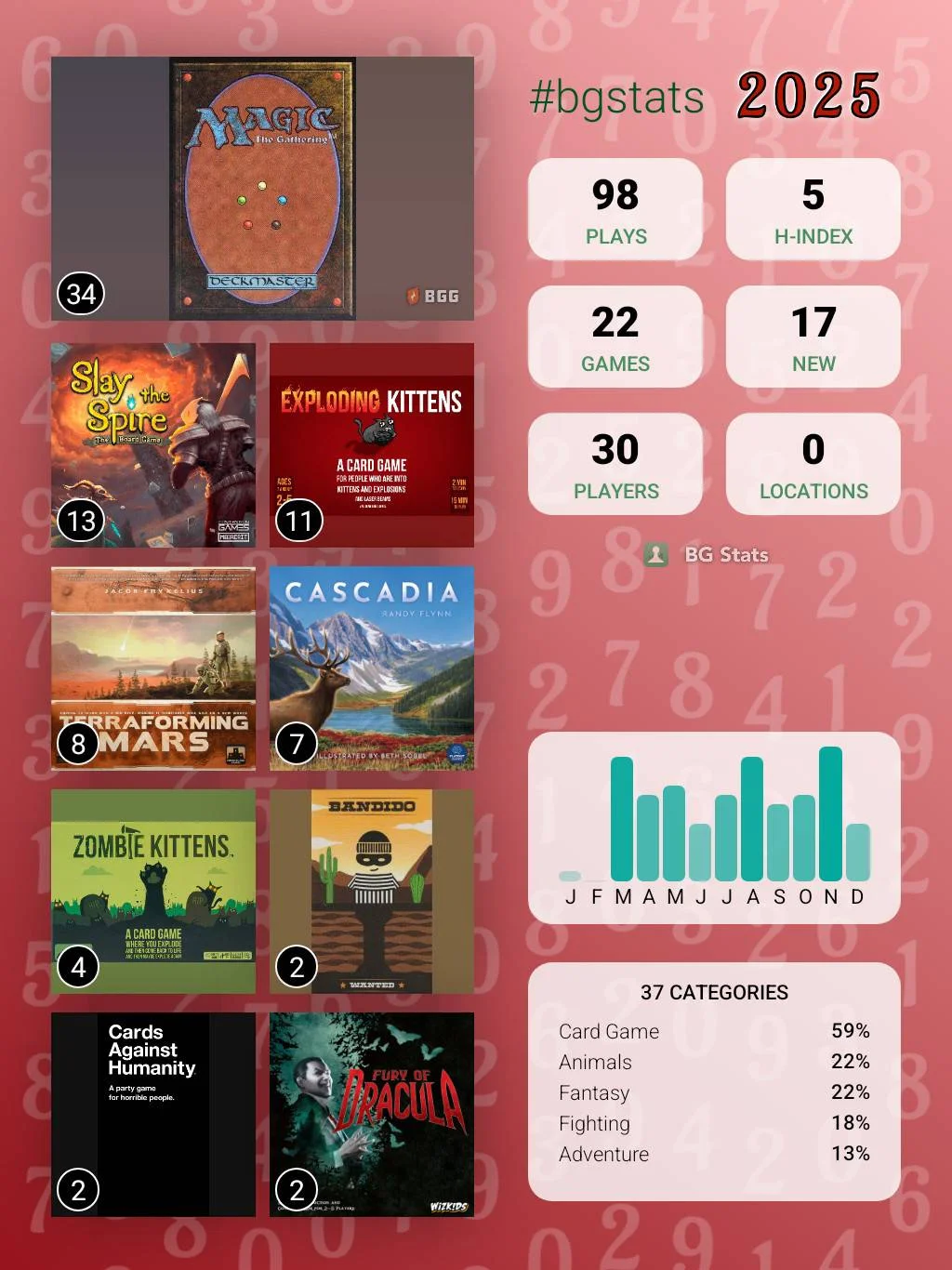
The clearest lesson from this group’s 2025 gaming year is that a few strong favorites can share the table with plenty of one-off discoveries. Weekly board game gatherings at a local game store helped make regular play part of the routine, and the collection grew along with it. The group also juggles roleplaying games and Magic: The Gathering, so its board game totals reflect a busy hobby life rather than a dedicated board game schedule.
This year-end review is a record of what reached the table, what earned another session, and what the group wants to make time for in 2026. The numbers are modest by the standards of some veteran hobbyists, but they reveal a useful mix: a cooperative campaign-style favorite, accessible games for newcomers, and heavier titles that reward a longer evening.
The games that became regulars
Slay the Spire made the strongest impression over extended play. The cooperative deckbuilding adaptation of the video game supports up to four players, each taking a different character on an ascent through a tower of monsters and encounters. The party has to work together; if one character dies, the run ends. Its replay value comes from the variety built into the game, with achievements and higher difficulty levels giving experienced players further goals. It also offers a satisfying solo option.
The group expects it to remain a central pick in 2026. It also took the year’s time-sink honor: the sessions recorded in the group’s log add up to 37 hours, though the authors aren’t certain every play was entered. That total says something about the game’s pull. It’s easy to return for another run when new challenges and deck decisions keep changing the shape of a session.
Exploding Kittens and Zombie Kittens claimed the most-played spot, with 15 plays between them. Both are brisk, colorful card games built around dodging a bad draw while using cards to disrupt opponents. Zombie Kittens stands on its own, adds cards and rules, and lets a player remain in the game after exploding. The two titles can also be combined into a larger game.
That quick pace helps explain their repeat appearances. They work for families, parties, travel, and the familiar gap before everyone has arrived. The group usually packs at least one for trips, so their place in the rotation looks secure. Slay the Spire was the runner-up in number of plays, despite its longer sessions.
Terraforming Mars has a different kind of staying power. Players represent corporations trying to make Mars habitable, balancing resources and building engines in a competitive science-fiction setting. The base game has a solo mode, while the many expansions add more choices to manage. The group notes that choosing how many expansions to include can itself become part of the planning.
It’s also the game where Chris most often sets aside the clearest route to victory and plays the cards he likes. That approach doesn’t always pay off, but it’s become part of the table’s running joke. The group expects to play Terraforming Mars several times a year, with Chris still chasing that elusive win. Players curious about how the add-ons change the experience can find more in the group’s look at the expansions.
Accessible games with room to grow
Cascadia was the group’s standout recommendation for new players. Players build habitats from tiles and populate them with wildlife, while scoring goals depend on cards selected at the start. That setup gives the game a straightforward first teach but plenty of variation from one session to the next. Achievements and an enjoyable solo mode offer more reasons to return.
Chris has a particular fondness for the pink salmon tile, and collecting them can even become a viable strategy. More broadly, Cascadia earned praise as a quick setup with enough flexibility to meet players where they are. It’s suited to families, solo play, travel when there’s room for the box, and anyone easing into the hobby. The group plans to keep it in regular rotation and feels it deserved more table time this year.
Flamecraft brings a gentler, more whimsical mood. Players build reputation by helping dragons and shopkeepers, gathering items and placing enchantments. There’s room to pursue the actions that look appealing, and solo play is supported. The group describes it as an ideal lazy Sunday game with tea close at hand.
It also took the group’s award for cutest game, narrowly edging out Cascadia. The deciding image was a pastel dragon baking a pastry—apparently a hard scene to beat. Picking a favorite dragon is its own challenge when every one of them is adorable.
Sushi Go! offers a quick drafting experience with a little more thought beneath its simple rules. Players collect combinations of sushi dishes, and watching which cards arrive can reveal what neighboring players are building. You can draft to disrupt those plans, or simply take the cards you enjoy; either approach works. The group doesn’t reach for it as often as Exploding Kittens when it wants a fast game, but it still makes a welcome change of pace for families, parties, trips, and drafting fans.
The Mind asks a team to play numbered cards in ascending order without speaking. A player who holds a lower card than one already played costs the group a life, while each level adds more cards to manage. The goal is to finish every level. The group’s verdict is brief: some players are psychic, so it stays in rotation, and its small, portable format suits travel.
Discoveries from game store tables
Several titles came to the group through demonstrations at the local game store, hosted by the owner or other players eager to share a favorite. These one-time introductions brought a broader range of mechanics to the year, with some clearly earning a return visit.
Fury of Dracula sets one player against a team of hunters in a pursuit across Europe. The Dracula player tries to hide vampires, while the hunters work together to find and destroy them; Dracula wins if six vampires remain hidden. The group found it distinctive and worth trying, though it takes attention and time. They’d especially like another session with the player who introduced it and made such a strong Dracula.
Bandido distills cooperative route-building into a compact game. Players coordinate to block escape routes before the cards run out. Its premise is easy to grasp, but the puzzle can become surprisingly demanding. The group had fun and would gladly play again, particularly as a travel option or a quick game while waiting for late arrivals.
The Quacks of Quedlinburg puts players in the role of potion brewers trying to score points without making their mixtures explode. The changing elements from round to round help keep the game fresh, and the group found it easy to learn. Its appeal is clear for anyone who enjoys testing their nerve; the players felt their potions didn’t explode often enough and want another go.
Age of Conan: The Strategy Board Game combines strategic kingdom-building with luck. Players control kingdoms in the Hyborian age, bid each round for Conan’s attention, contest territory, and grow their armies. The rules can be tricky, so a careful teach matters. Fans of Conan or strategic games may find it worth exploring, though Chris was lukewarm and would likely return more for the company than the mechanics.
Alhambra offers a gentler introduction to more involved tile placement. Players buy and arrange tiles to build their own version of the famous complex, with drafting and decisions that can help their plans or interfere with rivals. The group found it simple and enjoyable, a good step up in complexity without overwhelming new players. Its verdict on a replay: yes.
Bomb Busters reminded the group of The Mind, but adds more components and a deduction puzzle. Teammates try to defuse a bomb by working out which cards other players hold. The margin for mistakes is narrow, making careful observation and reasoning central to the fun. The group is eager for more sessions.
Bonanza, a card game that has been around for almost 30 years, keeps its premise plain: plant beans, harvest them, and trade with other players to get the beans you need. That simplicity appealed to Chris, who has been advocating for a replay. The group expects to give in soon and return to the bean fields.
Harmonies drew a comparison to Cascadia, with Chris calling it a three-dimensional version. The group saw the resemblance, but found that building vertically gave it a distinct pleasure. Fans of Cascadia may enjoy the connection, and this group would play Harmonies again.
The Briefies: the year’s table awards
The group’s informal awards capture what the play log alone can’t: which titles suited a particular mood, brought new players in, or produced a memorable table image.
- Time sink: Slay the Spire, with 37 logged hours, subject to the caveat that some plays may be missing.
- Most played: Exploding Kittens and Zombie Kittens, with 15 plays. Slay the Spire came second.
- Best between online meetings: Solo Cascadia gave Chris something enjoyable to set up in a short break, without taking much space. Lost Cities: Rivals was the runner-up, though it needs another player in its standard form.
- Best for new players: Cascadia, thanks to its easy teach, quick setup, and scoring cards that can shift the challenge.
- Cutest: Flamecraft, just ahead of Cascadia, on the strength of its pastel dragons and pastry-making.
- Most likely to ignore the objective: Terraforming Mars, where Chris tends to choose the cards he likes and see where that takes him.
That last award is less a critique than a reminder of why a group’s habits matter. A game can offer a clear goal and a carefully tuned route to reach it, but players bring their own priorities to the table. Sometimes the preferred cards win out over the plan.
What the group wants to play in 2026
The coming year’s list mixes a return to a known favorite with new titles the group has heard about or received. Mage Knight is the familiar one: the group played it at the local game store in 2024 and enjoyed it. Its longer play time makes sessions harder to arrange than a quick filler, but they intend to bring it back in 2026.
Sky Team has reached the list through recommendations from online sources and trusted local players. The group is keen to see what those enthusiastic reports amount to at the table. Aeon’s End is a less familiar prospect; an invitation to try the cooperative game was enough to secure a spot on the schedule.
SETI has caught Chris’s eye at the local game store, where he keeps admiring the copy. The group wants to find out whether the experience matches its striking presentation. They’re also planning to try two games received from Rio Grande Games. Seas of Strife looks like it could meet their ongoing desire for games that are quick to learn or teach, while Jump Drive has drawn interest for its solo play. The group plans to give that one a thorough try.
Slay the Spire may already have another long session on the calendar: the writers expect to try a four-act run at their next game day. Between that return and the new titles on the list, the group’s 2026 schedule has a clear shape—make room for the games that earned repeat plays, then keep a few open seats for someone else’s favorite discovery.
===

