ARDEVUR Review: Mining, Markets and Risky Resource Sales
Story by AnastasiosHJW · 995 readers
ARDEVUR pairs mine building and resource management with volatile sales and player interaction. Its disruptive Action Cards may need another pass.

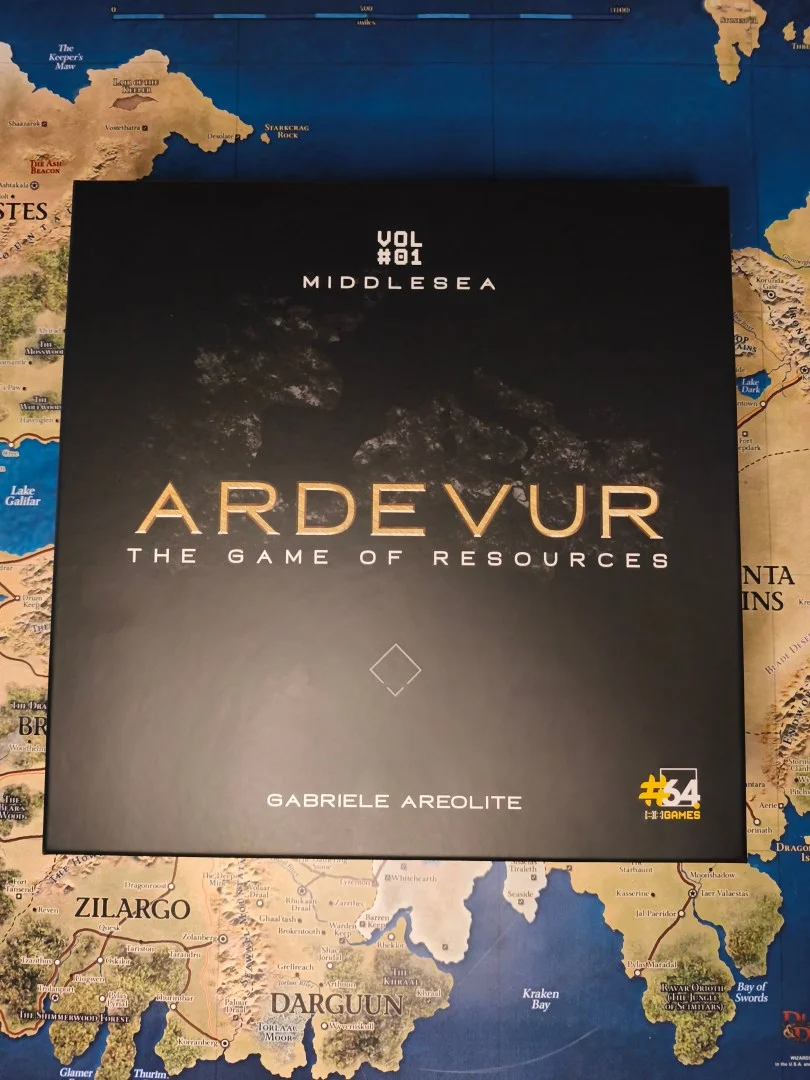
ARDEVUR: The Game of Resources has a strong economic engine at its center: claim territory, build mines, move resources into the market and turn that work into points. The tension comes from managing limited development cards, choosing when to sell and deciding how much risk to accept when prices fluctuate. Hashtag 64 Games sets the contest among mining companies in modern-day Africa and Europe.
For 2 to 4 players, a game typically runs 1 to 2.5 hours, depending on the table size. The publisher supplied the reviewer with a free copy. The game was still in development at the time of writing, with a GameFound project expected to go live soon, so the rules and balance may change.
What’s in the box
The box packs a sizeable set of components into a tidy space. Its boards fit together, and small notches make them easier to lift apart. It’s compact enough for a shelf, though the reviewer wouldn’t consider it an easy game to carry around in a backpack.
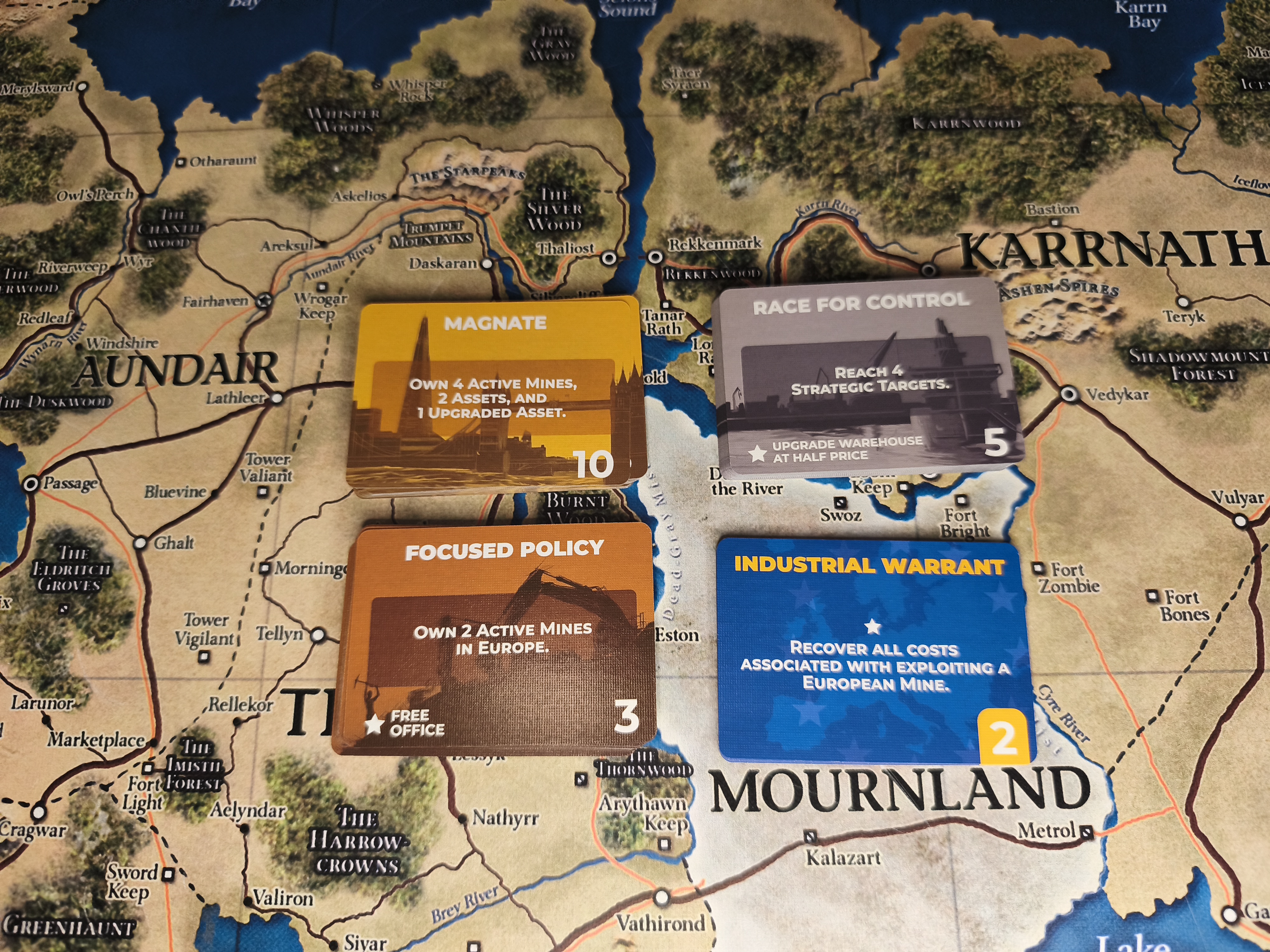
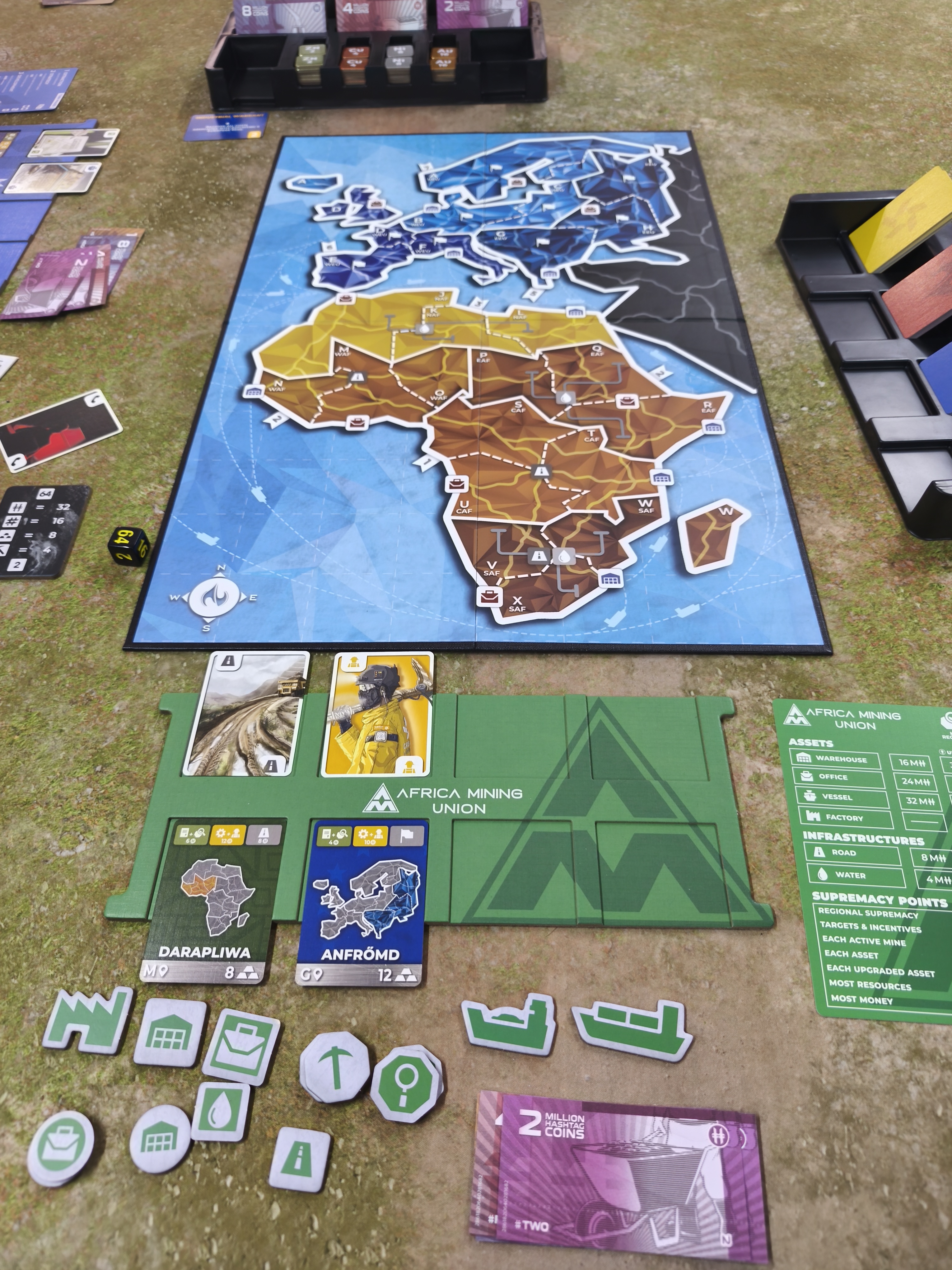
The central play area is a foldable map board, supported by 24 Territory Cards that determine where mines can be built. Players also share 18 Development Cards, 40 Strategic Target Cards in Bronze, Silver and Gold tiers, and 6 Government Incentive Cards. Strategic Targets provide Supremacy Points, but can also be spent for bonuses; Incentives offer another route with different requirements.
Each of the four corporations has a Corporation Card, a dashboard, 14 colour-coded Map Markers and 16 Action Cards. The 56 markers represent mines, offices, warehouses and other structures, with double-sided pieces showing some upgrades or changes in status. The rest of the kit includes 40 resource tokens across four values—Zinc at 2, Copper at 4, Silver at 8 and Gold at 16—plus 96 bills in six denominations from 2 to 64, each tier doubling the one before it.
A Target Grid holds the Strategic Targets during play, while two Market Organisers keep cards, money and resources within reach. The box also contains a six-sided die marked 2, 4, 8, 16, 32 and 64, and a rulebook. That unusual die matters: it shapes both territory selection and the price check when players sell globally.
Claiming ground and taking turns
Setup scales the available Strategic Targets, Incentives and Development Cards to the player count. Players choose a corporation, either by agreement or by rolling for selection order, and take starting capital, two Development Cards and an Action Card. The standard mode includes Action Cards; Fair Play leaves them out.
The opening auction establishes each company’s first two territories. Players roll in turn, and the highest result chooses first. Each selected Territory Card is replaced before the next choice, so the options stay open as the process continues. A lucky player can claim both starting locations before another player gets a pick. Later, a second auction adds two territories per company. There’s no fixed round for it: any player can call it once everyone has at least two active mines.
Each turn follows four phases. During Extraction, an active mine produces the resources shown on its Territory Card. Normally, a player extracts from only one mine per turn; an Office expands that capacity. In Strategy, the player chooses to take one or two Development Cards, draw an Action Card or claim the Telephone card. That special Development Card acts as a wildcard, but using it costs double.
The Development phase is where players build, improve their position and sell resources. Finally, the Reward phase lets a player claim a Strategic Target or Government Incentive if they meet its requirements, with a limit of one per turn.
A player can call “Total Control” to trigger the endgame if at least one Gold target has been claimed, all Bronze and Silver targets are gone, or someone holds at least 24 Strategic Target and Incentive cards combined. After the final round, players total their Supremacy Points; the highest score wins.
Development, access and the market
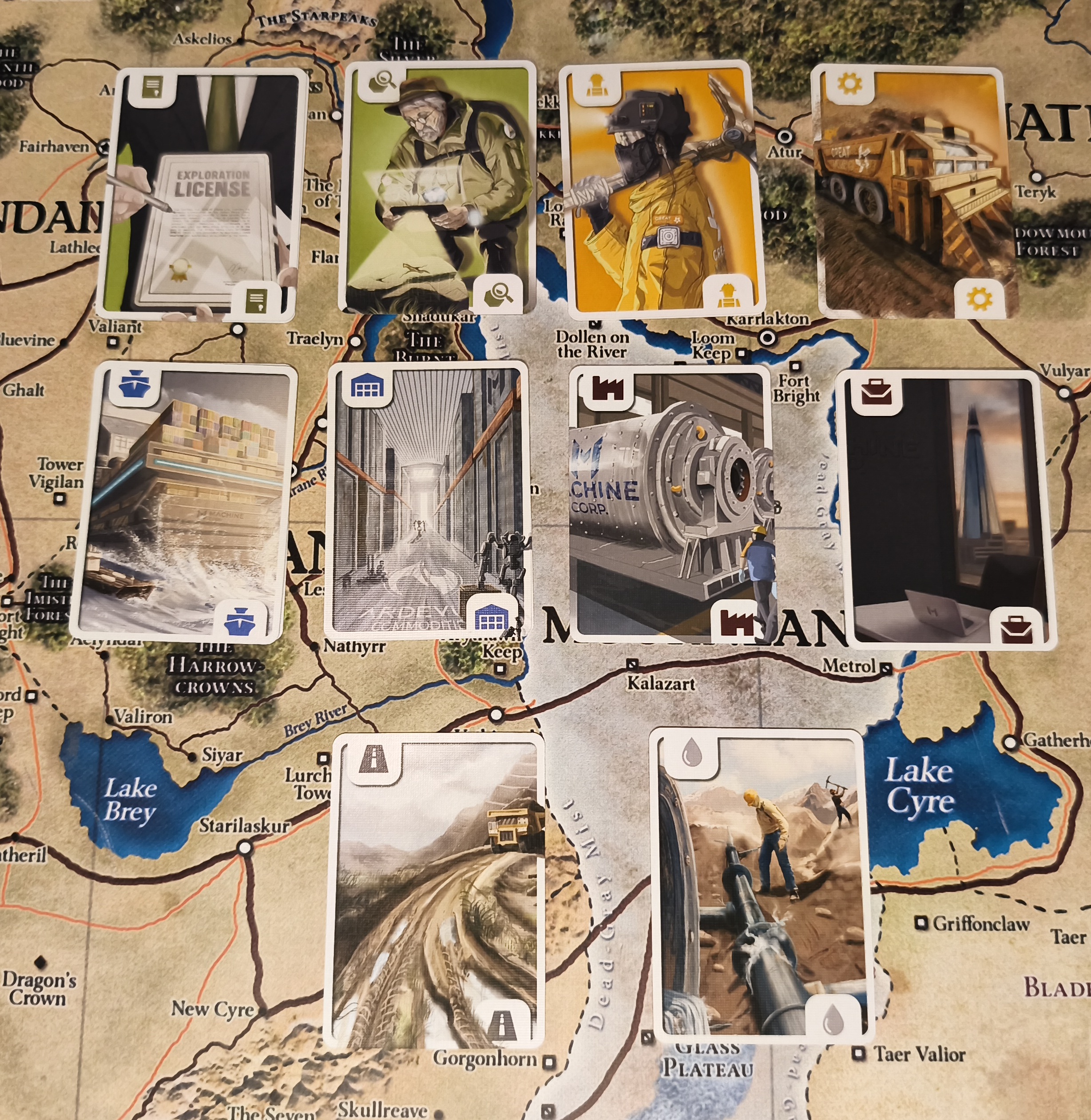
Most construction depends on collecting the right Development Cards as well as paying the cost printed on the relevant territory. An exploration site takes a Licence and Geologist card; turning it into a mine requires Machinery and Workforce. Roads, Water infrastructure, Offices, Warehouses, Vessels and Factories each call for their own cards. That makes the shared supply a direct point of friction, especially with two players, when only one copy of each card is available. Taking a card can stall an opponent’s plans, even if you don’t need it yourself. They may have to spend extra on the Telephone card—or try to negotiate a trade.
Corporation choice offers a small exception to that card bottleneck. Each company has a built-in development specialty that removes one requirement from mine construction. Machine Corp, for instance, doesn’t need Machinery; Ardevur Commodities can build without a Licence card. That asymmetry gives players a reason to consider their corporation alongside the starting territories and early cards.
Assets expand what a company can do. A Warehouse increases storage from a base of 32, doubling capacity to 64 and then, when upgraded, to a maximum of 128. A Vessel lets its owner sell stockpiled resources at double price, making it potent but costly. An Office allows extraction from two mines on the same continent; an upgraded Office raises that to three mines anywhere. Infrastructure can be just as necessary: some territories require Water, Roads or both. Without Water, resources sell for half price; without a Road, they can’t be sold.
Selling creates one of the game’s clearest risk decisions. Local sales pay half price, but leave room for another Development action in the same phase. That can be useful when a player needs money and still wants to build, or when a full warehouse is looming next turn. Global sales start at full price, then the die sets the market adjustment: a 2 halves the return, while a 64 doubles it. The swing can make a sale lucrative or painful, so players must weigh immediate cash against the chance of a better result.
Action Cards and the balance question
Action Cards are the least settled part of the design. Each corporation has its own deck, giving the companies much of their distinction, and the cards can interrupt opponents or provide extra benefits. In practice, the reviewer preferred Fair Play, which removes them. Some effects can make an opponent lose a turn, take all the money from a resource sale or destroy a mine. Those plays create sharp swings that felt excessive in testing.
There’s a case that shared access should even things out, but that wasn’t the reviewer’s experience. The deck also contains gentler effects, such as letting a player go first in a territory auction without rolling. Those cards sound more in line with the game’s tactical pace, though the reviewer found them too situational to compete with the harsher options. Bringing the deck closer to that modest power level could make its company-specific interactions a real strength.
Early impressions
ARDEVUR already has an appealing mix of planning and uncertainty. Players build an economic network, but the limited card supply can turn development into a contest of timing and denial. Resource sales add another layer: taking a predictable half-price return may be wiser than gambling on a global price roll, particularly when a player needs funds for a specific build.
The rules take a few rounds to settle in, and some edge cases send players back to the rulebook. Once the turn structure clicks, though, the cycle of extracting, developing and claiming rewards is easy to follow. The reviewer also sees room for negotiation around scarce cards and competing plans, even though the finer details of those interactions aren’t fully covered here.
The main caveat is the Action Card balance, alongside the possibility of large price swings. Players who enjoy volatile markets and direct interference may welcome that edge; groups wanting a steadier economic contest can try Fair Play. With some tuning to the disruptive cards, ARDEVUR looks like a promising addition to a regular game rotation.