Hidden Realms: The Mummy’s Tomb Turns Dice Rolls into a Tomb-Mapping Puzzle
Story by AnastasiosHJW · 974 readers
Map an ancient tomb in 20 turns, balancing dice, gold and open routes in this portable solo or group puzzle from Spyros and Myrto.
Hidden Realms: The Mummy’s Tomb makes a lot out of a small play space. Spyros and Myrto, the Greek creators behind Tabletop for World, have built a compact puzzle around dice, tile placement and the shape of the route you draw through an ancient tomb. The dice introduce uncertainty, but the real challenge is keeping enough routes open to make useful choices when a particular result doesn’t arrive.
The game is currently seeking backers on GameFound, with its project due to end less than a day after the original review was posted. Its format is unusually approachable: everything fits on one page, and players need only two standard six-sided dice, a pencil and an eraser. A digital copy works, too; the reviewer played by opening the page image in Paint and drawing lines on it.
A map that doubles as the play area
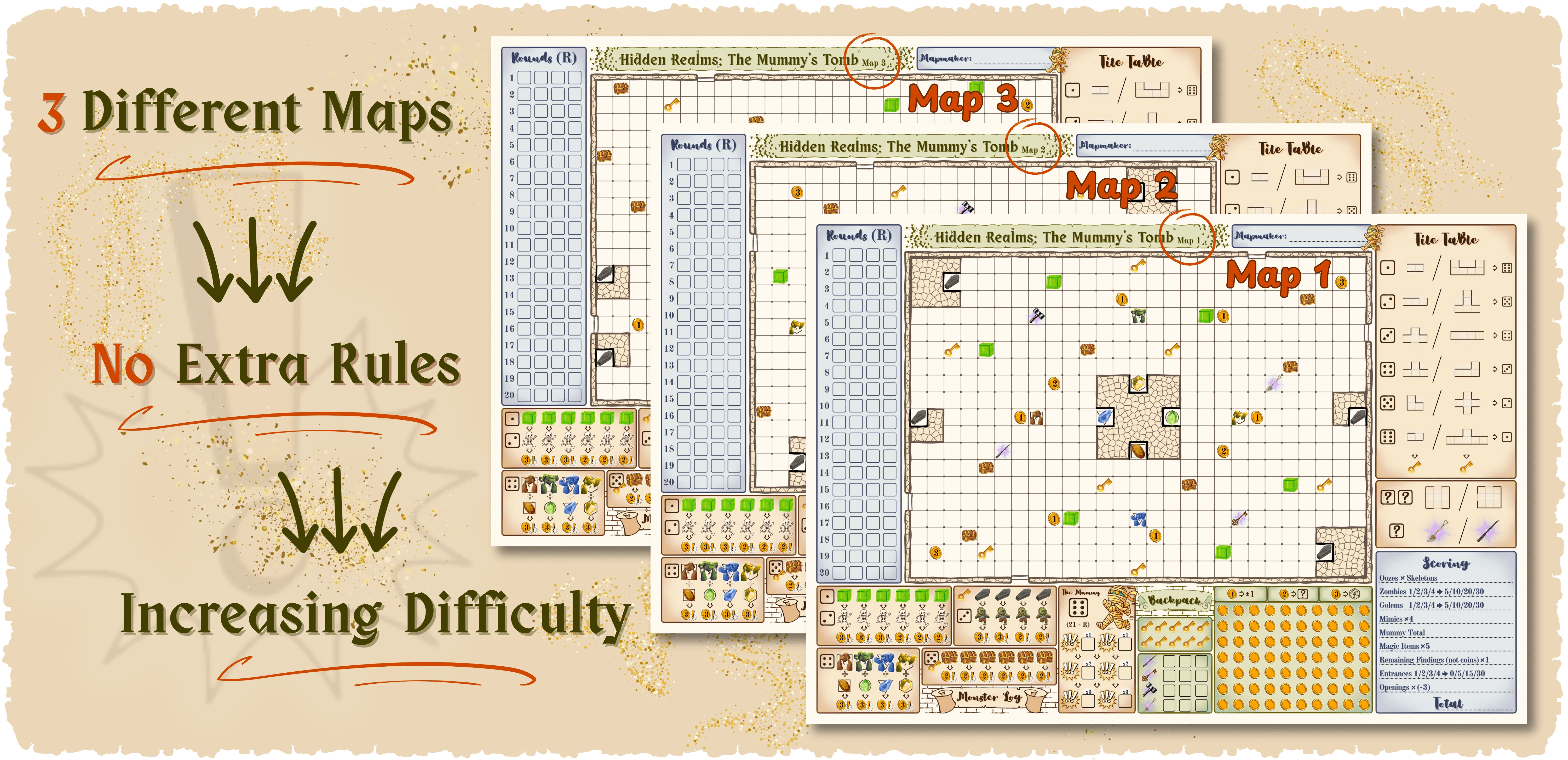
The sheet brings the whole puzzle together. The tomb map marks points of interest, a reference table lists the tiles associated with dice results, and a turn tracker records each roll. Notes at the bottom help players track defeated enemies and collected loot. It’s a tidy design, though the first play may take a little time as players learn what each symbol and option allows.
One player can explore alone, aiming to beat a previous score, or a group can compare results. The rules allow any number of players, though the reviewer recommends keeping the table to four. Each game lasts exactly 20 turns. At the end, the highest score wins in group play.
Scoring rewards several kinds of progress. Defeating zombies, golems, slimes, skeletons, mimics and the Mummy earns points, while magic items add their own value. The map itself matters just as much: linking the route to additional entrances can score points, but leaving open ends in the path costs points. That gives the puzzle a useful tension between reaching new places and making the finished layout feel complete.
Dice set the options; the map makes the plan
At the start of a turn, roll two dice and record the results in that turn’s boxes. Each result offers two possible tiles, chosen from the reference table. Mark the options as they’re used: completing a row of marked boxes grants another die, while completing a column awards a key. Players can also combine two rolls to create a larger 3-by-3 room, or spend a roll to add or remove a single wall.
Gold gives the player more control. One coin raises or lowers a roll by one; two coins buy an extra die, up to four dice in a turn; and three coins let the player choose a result outright. Tile placement still has a spatial constraint: a new tile’s doors must connect with a tile already on the map. The first tile is the exception, and must start at one of the four entrances.
That connection rule is what turns a list of dice results into a spatial puzzle. A strong roll is only useful if there’s a place to put its tile, and a route that looks efficient can become awkward if it leaves too few connection points. The reviewer’s advice is to sketch out multiple possible routes and keep two or three available. A plan that depends on one exact result can stall; a map with alternatives can keep growing.
The tomb offers four main rewards and obstacles. Gold buys extra dice or adjusts results. Enemies can be defeated by spending rolls, yielding points and coins while bringing the Mummy closer to awakening. Keys open sarcophagi containing zombies and unlock mimic chests. Four distinct magic items provide powerful effects, each usable three times without consuming a dice action.
The Mummy has a special requirement: defeat three enemies before attacking it, then use a six. A successful hit scores Fame equal to 21 minus the current turn number, so striking earlier is worth more. But the six is also a valuable tile result, associated with both the longest five-square tile and a small corner piece that can be essential for turning a route. Choosing when to spend it on the boss is one of the game’s sharper trade-offs.
Build reach before chasing every reward
The reviewer’s strongest strategic point is that access to space often matters more than finding an ideal route. A long, straight passage may look plain, but it can open a large section of the map. From there, players can branch toward specific rewards as useful dice results appear. The Shovel and Wand help reshape a route: the reviewer uses them to remove a wall or create a turn, and says they can be used with any dice roll.
This perspective also changes how gold gets spent. The reviewer tends to use coins aggressively, often paying two for another random die rather than three to select an exact result. Early in the game, another chance to extend the map can be more useful than forcing one particular tile. More reach creates more places to use future rolls, and access to more gold and tools can keep that flexibility going.
Enemies, meanwhile, don’t have to be rushed. The reviewer says they’re worth treating as a reserve option: when a roll doesn’t fit the map, spending it to defeat an enemy can generate coins, which can then fund another roll. There’s no score difference from defeating an ordinary enemy early or late, according to the review. The Mummy is the exception because its earlier defeat earns more Fame, although pursuing it can slow down tile placement and compete for the same sixes needed for useful rooms.
A small game with room to improve
The reviewer has played only solo, so the group experience remains untested in this account. Even so, the report is enthusiastic: the game is short, easy to carry, quick to understand after an initial learning round and replayable thanks to the changing dice results and route decisions. The reviewer’s personal best was 235 points on the second play, a score they haven’t matched since.
Hidden Realms: The Mummy’s Tomb looks most appealing to players who enjoy turning uncertain inputs into a plan they can adapt. Its one-page format keeps setup light, while the 20-turn limit gives the spatial puzzle a clear finish line. Leave yourself options, grow the map early and decide carefully when a six belongs to the Mummy.