Slay the Spire Board Game: Achievement Tips and Infinite Combos
Story by AnastasiosHJW · 633 readers
A guide to Slay the Spire’s toughest achievements, with practical routes to repeatable card combos for all four characters.


Slay the Spire’s achievements give a strong reason to shape a run around an unusual goal. Some arrive naturally as you learn a character; others ask you to build for a single turn, keep a tiny deck alive through three acts, or assemble a loop from a narrow set of cards. The infinite-combo achievement is the biggest puzzle of the lot, especially because the board game offers fewer repeatable tools than its video game counterpart.
Here’s a practical look at the full set covered here: which goals are easy to pick up, which need a deliberate run, and what card sequences can keep cycling once the pieces are in place. The difficulty labels below reflect how demanding each achievement looks in play, rather than a promise that it will happen on a particular run.
Achievements that come naturally
Jaxxed: reach 8 Strength
Difficulty: Trivial. Ironclad is the straightforward choice. Limit Break can push Strength to the required level quickly, while Demon Form and Spot Weakness can get there over several turns if the fight lasts long enough.
The other characters have fewer convenient routes. Silent generally needs a relic to gain Strength. Defect can use Reprogram, though it takes time to build up. Watcher can gain Strength with Wish, but its two Strength is only a start. Wreath of Flames offers another route: with enough Miracles, you can gather the energy to raise it to 8, since Miracles can be spent to pay for a card immediately.
Catalyst: reach 30 Poison
Difficulty: Trivial. A Silent Poison deck should get there without much trouble. Burst followed by Catalyst is the quickest path, while stacking Poison over multiple turns can work if the enemy lasts long enough. That’s the main catch: many targets will fall before you reach 30.
Ninja: play 7 Shivs in one turn
Difficulty: Trivial. A Silent Shiv deck can make this happen with a little planning. Keep five Shivs available, then generate two more in the same turn. Once all seven have been played, the achievement is yours.
Powerful: have 7 Powers at once
Difficulty: Easy. Defect is a good candidate, though every character can manage this with some planning. Ironclad and Silent each have 10 Powers, including five Rare cards. Defect and Watcher each have 12, also with five Rare cards.
Watcher has a wider mix of Powers, but the cards don’t always support one another. Defect’s options make a concentrated Power turn more comfortable: Heatsinks rewards playing Powers, Force Field can become easier to play, and the character’s Orbs provide more ways to build toward a strong board. The achievement asks for seven Powers in play at once, so plan for the number of cards you can draw and pay for in a single fight.
Block, bosses, and table-wide goals
Barricaded: reach 20 Block
Difficulty: Easy. Ironclad has the cleanest route, thanks to Entrench. A large Block burst from Impervious can also do the job, or Barricade can let you carry excess Block from one turn to the next until you reach the limit.
Silent has plenty of Block potential, but usually needs more setup. Footwork helps; even two Dodge and Rolls alongside Survivor only bring the total to 16, so you’ll need another source of Block as well.
Defect has several ways to approach the target. Reinforced Body at maximum energy gives 12 Block, and Multi-Cast on a Frost Orb can reach the same amount. Consume raises that figure to 18, leaving just a little more Block to find from Recursion or additional Frost Orbs.
Watcher can use Wish for 15 Block, then add a small amount from another card. Wallop is another possibility, though it asks for a more specific setup. Make an enemy Vulnerable, enter Wrath, and use Simmering Fury to help Wallop reach 12 damage and therefore 12 Block. Strength, Blasphemy, Omniscience, or a separate Block card can close the gap.
You Are Nothing: defeat a boss on turn 1
Difficulty: Medium. This calls for a deck built around a huge opening burst. Poison, Shivs, and Orbs can all deal substantial damage, but their setup usually takes too long for a turn-one boss defeat. Ironclad Strength and Watcher Wrath look like the best foundations.
Act 2 is a sensible target: Act 1 bosses may be harder to take down immediately, while an Act 3 deck may be powerful enough but face a tougher opponent. You’ll need the right cards in your opening hand, and relic effects may need to cooperate too. Treat it as a focused attempt rather than something likely to happen by accident.
All for One: beat Act III with 4 players
Difficulty: Trivial if four people are playing; impossible otherwise. This goal depends on having a full group. With four players, complete Act III together. If you don’t have four people at the table, there’s no route to this achievement in that session.
Perfect: beat a boss with all players at full HP
Difficulty: Medium. A support-focused Silent can help a group protect everyone, but a strong solo deck can also defeat a boss without losing HP. Poison can end a fight before it gets out of hand; Defect’s Orbs offer offense and defense; and Ironclad can build enough Block to withstand incoming attacks. Watcher may find it harder to maintain her health.
The important detail is the starting condition. The achievement requires everyone to be at full HP when the boss is defeated. Avoiding damage during that fight isn’t enough if someone enters it already hurt. A campfire rest can solve that, though it may mean giving up an upgrade. When the gap is just 1 HP, you’ll have to decide whether the rest is worth it.
The Transient: defeat the Transient before it defeats itself
Difficulty: Medium. You have several turns to deal the damage, and hitting the Transient also gives you Block. That lets the group focus on attacking rather than splitting effort between offense and defense. The encounter is less predictable than a boss, so it can be awkward to arrange a try, but the damage window makes this more forgiving than a turn-one boss defeat.
Collector: finish Act III with 12 Relics and Boss Relics per player
Difficulty: Medium. The boss fight itself may be manageable; the demanding part is surviving enough Elite encounters to collect the required Relics. With two Boss Relics, you still need 10 more, unless a Relic such as Whetstone or Enchiridion is discarded rather than kept.
A route with two Elites per act yields six Relics, or seven if one act’s route lets you reach a third. That leaves three or four to find through shops or events. The goal rewards a route with several Elite fights, but every extra detour raises the risk of arriving at the boss in poor shape.
Deckbuilding challenges and character completions
Minimalist: beat Act III with a deck of 5 cards or fewer
Difficulty: Very Hard. You need to remove cards aggressively while resisting the usual temptation to add new ones. That’s a difficult balance early in the run: extra cards can help you survive Act 1, but every addition makes the final deck target harder to reach.
A favorable Neow’s Blessing seems like a useful start. In a group, one player could focus on trimming their deck and surviving while others handle more of the work, though it’s uncertain whether that approach satisfies the achievement. For a solo attempt, every card choice has to serve the goal without leaving the deck too weak to progress.
Common Sense: beat Act III with no Uncommons or Rares
Difficulty: Hard. Commons can make a functional deck, but losing access to higher-rarity cards also removes many of the strongest tools, including Powers. Each character has a possible angle, though none makes this an easy run.
Ironclad has cards such as Heavy Blade and Pommel Strike, but Flex is the only Common source of Strength described here, and its bonus lasts only temporarily. Relics such as Akabeko, Vajra, and Red Skull can help. Du-Vu Doll may be another route if you can gather Curses and turn them into a steady source of Strength.
Silent has a thin toolkit for the job. Poison options are limited to Deadly Poison and Poisoned Stab. Blade Dance, Cloak and Dagger, and Slice can support Shivs, but there’s no Common way to boost their damage. Dagger Throw and Prepared provide discard, yet Sneaky Strike is the only listed Common payoff for that plan. Relics may help, but the card pool leaves little room to specialize.
Defect loses its Powers entirely under this restriction, which takes away a major part of the character’s engine. Ball Lightning, Chaos, Cold Snap, Coolheaded, and Recursion can support an Orb plan, though that may not be enough for the bosses. A zero-cost deck is another option: Claw, Scrape, and Steam Barrier can form its core, with Zap, Recursion, and Chaos adding some Orb support. It’s a possible plan, but its limits are hard to miss.
Watcher also lacks support for a focused Common-only strategy. Many Commons change stances, but the available cards may not turn those stance changes into enough momentum. As with Minimalist, a group might try to let one player pursue the requirement while others carry more of the run, though the source leaves open whether that counts.
Ruby, Emerald, Sapphire, and Amethyst: beat Act III with each character
Difficulty: Trivial. These four achievements ask for an Act III win with Ironclad, Silent, Defect, and Watcher respectively. Play through the act with each character to earn the matching achievement.
My Lucky Day: beat Act III with a Daily Climb
Difficulty: Trivial. A Daily Climb gives the run a randomly assigned positive modifier and a dangerous negative one. There are six of each. They don’t necessarily cancel each other out, but the pairing can balance the run, and some combinations may make the climb feel easier. Complete Act III in that mode to earn the achievement.
Who Needs Relics?: beat Act III without Relics or Boss Relics
Difficulty: Medium. The run can sound harsher than it plays. Relics offer useful bonuses, but much of a deck’s strength comes from its cards. You can skip Relics and still build a capable deck, though it may take a few attempts to find a card path that works.
Building an infinite combo
Infinity asks you to create an infinite card combo, and it’s one of the hardest achievements here. You need a specific set of cards, a deck small enough to find them, and a way to keep paying for the loop. The board game has fewer repeatable effects than the video game: Sundial, Tactician, Turbo, Unceasing Top, and Rushdown offer examples of repeatable energy or draw there, but the board game doesn’t give you all those routes.
There is one helpful difference: the board game has no maximum hand size. That can make it easier to gather the combo pieces before starting the loop. In general, a working infinite needs three jobs covered: energy, card draw, and damage. The two repeatable energy sources discussed here are Defect’s Turbo and Watcher’s Calm stance. Turbo adds Daze to the discard pile; Calm requires you to leave and re-enter the stance. Those costs shape which loops are practical. Zero-cost draw and damage cards can also reduce the energy burden, though they narrow your options.
Combo 1: Colorless loop
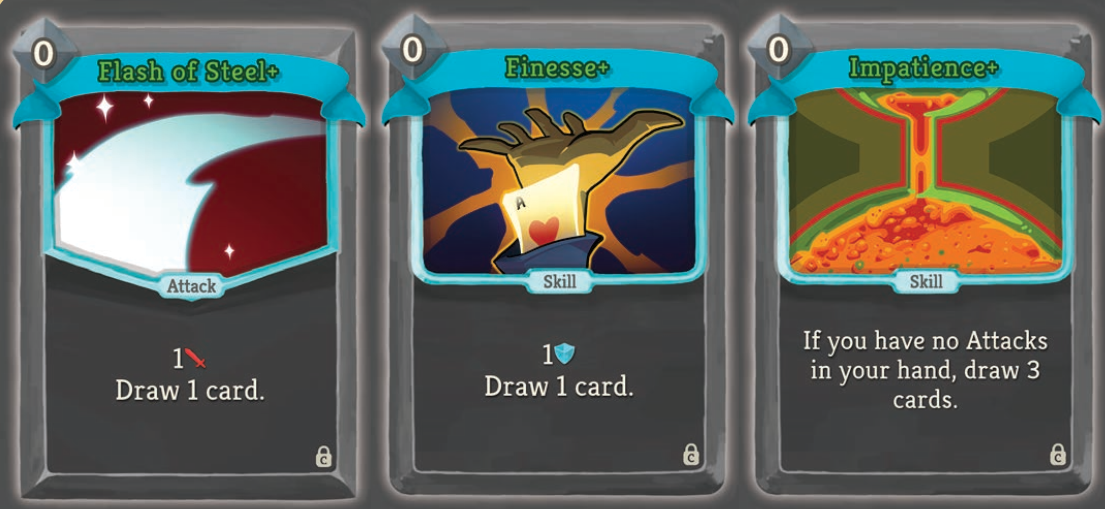
The simplest version uses two Colorless cards: Finesse and Flash of Steel. First, draw your whole deck into your hand. Play Finesse, then Flash of Steel; the latter draws Finesse back. Play Finesse again to draw Flash of Steel, then repeat. The two cards keep returning each other while Flash of Steel supplies damage.
Shops are a good place to look for both cards, and a Colorless card option from Neow’s Blessing can help. They’re useful beyond this loop, too: both offer repeatable zero-cost draw, and Flash of Steel contributes damage.
Impatience can stand in for Finesse, provided there are no other Attacks in your hand. It can also replace Flash of Steel, but that version needs a separate zero-cost Attack and Finesse. Start by playing the Attack, then Impatience to draw it, followed by Finesse to draw Impatience. Play the Attack again; Impatience now draws both the Attack and Finesse. From there, Finesse brings Impatience back, and the sequence continues.
Combo 2: Silent loops
Silent’s Escape Plan provides zero-cost draw, and Thousand Cuts can turn repeated card play into damage. The basic version also needs a second zero-cost draw, such as one of the three Colorless options, or Doppelganger played for zero to copy Escape Plan.
- Draw your entire deck into your hand, then play Thousand Cuts.
- Play Escape Plan.
- Use Doppelganger to copy Escape Plan. The copy draws the original Escape Plan, and shuffling the deck triggers Thousand Cuts.
- Play Escape Plan again to draw Doppelganger and trigger Thousand Cuts once more.
- Repeat the sequence.
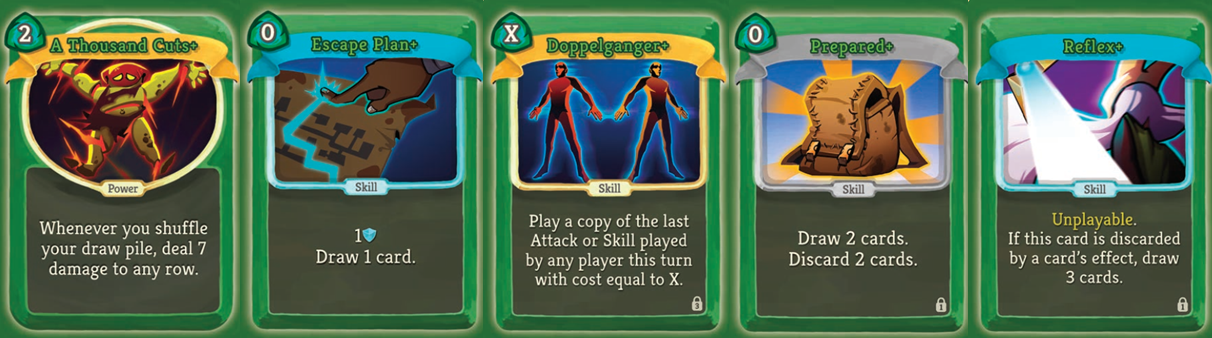
A more involved Silent loop can avoid Colorless cards. It needs Prepared, Reflex, another zero-cost draw such as Escape Plan, and Thousand Cuts. Draw the whole deck and play Thousand Cuts first. Play Escape Plan so it reaches the discard pile, then play Prepared.
Prepared draws Escape Plan, which triggers Thousand Cuts. Discard Reflex. Prepared enters the discard pile, and Reflex draws cards because it was discarded; it draws Prepared, but not itself. Reflex then goes to the discard pile. Play Escape Plan to draw Reflex back, and repeat. The order matters: the discard and draw effects keep the cards cycling.
Combo 3: Defect loop
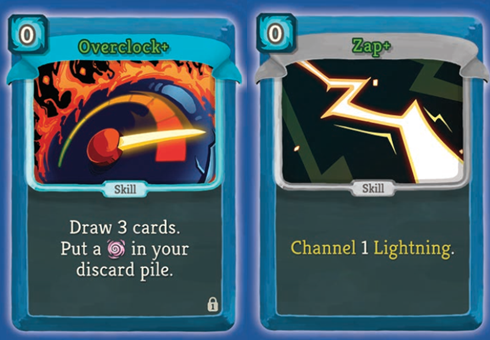
Defect can adapt the Colorless loop with its own zero-cost cards, including Zap, Recursion, or Claw. One version uses Finesse, Impatience, and Zap. After drawing the deck, play Zap, then Overclock. Overclock draws Zap and puts a Daze into the discard pile. Impatience draws both Overclock and the Daze, allowing the sequence to continue.
Overclock can replace Finesse, but Impatience still needs to be part of this version. Its extra draw is what clears the Daze from the cycle. There’s also a strict condition on Impatience: every Attack must be removed from your hand or exhausted before you play it, or its draw won’t work as intended.
Combo 4: Watcher loop
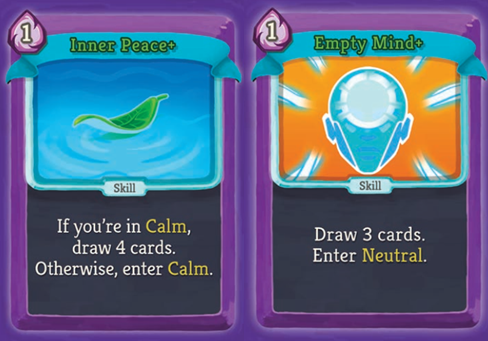
Watcher can use zero-cost Attacks such as Flurry of Blows, Consecrate, or Just Lucky with Finesse and Impatience. Her other route uses the energy gained by leaving Calm, though it still needs Colorless cards.
One version combines Flash of Steel, Empty Mind, and Inner Peace. Begin with the whole deck in hand. Play Flash of Steel, then Inner Peace to enter Calm, spending one energy. Empty Mind costs another energy and draws Flash of Steel and Inner Peace. Leaving Calm returns two energy, putting you back where you started in energy. Play Flash of Steel to draw Empty Mind, then repeat from Inner Peace.
Upgraded Empty Mind draws three cards, which can let you replace Flash of Steel with Finesse and one of Watcher’s zero-cost Attacks. You can also replace Empty Mind with Impatience, but then you need another way to leave Calm, such as Tantrum, Eruption, Indignation, or Empty Fist. One possible set of pieces is Impatience, Indignation, Inner Peace, and Flash of Steel.
Ironclad has no distinctive loop outlined here, but the Impatience, Finesse, and zero-cost Attack structure can still work. Body Slam and Anger are possible Attacks for that setup.
Getting the pieces into hand
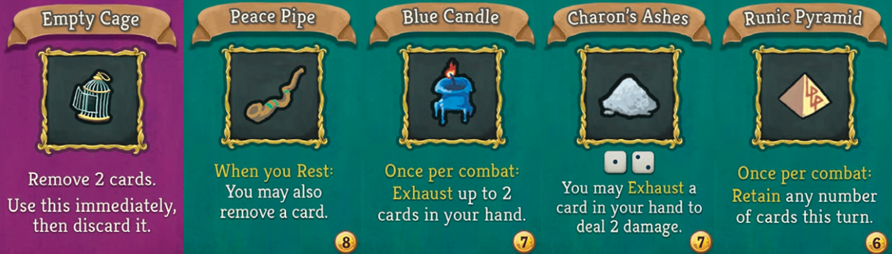
Every sequence above starts by drawing the entire deck. That step can take work, but there are ways to make it more likely. Removing cards at shops helps reduce the number of draws required, and Empty Cage or Peace Pipe can offer further deck trimming. Exhaust effects also help clear cards out of the way; Blue Candle and Charon’s Ashes are Relics to look for, alongside character-specific cards.
Extra draw and exhaust cards can speed up the setup, though each addition makes the deck larger and may make the key pieces harder to find. Purity can help exhaust cards, but a loop may already need several Colorless cards, leaving limited room for it.
Watcher has Blasphemy, though you’ll want the combo pieces in hand or discarded first so they aren’t exhausted. Retain can make that easier. Scrawl is an excellent draw option. Defect can use Recycle to exhaust a card, while Skim, Overclock, and Fission offer draw; Scrape can help because the combo pieces often cost zero.
Silent already has substantial draw, including her starting Relic, even without targeted exhaust. Ironclad has several exhaust options: Sever Soul, Second Wind, True Grit, and Burning Pact, which also draws. Offering provides another large draw effect. Dead Branch can turn exhausted cards into more draw, while Runic Pyramid can help keep the pieces gathered in hand.
Why the achievements work
Achievements give Slay the Spire’s runs an extra direction. Most of the straightforward goals can happen while playing normally, but the tougher ones ask you to make trade-offs: build around a turn-one burst, keep your deck unusually small, or choose a route that favors Relics and Elite fights. Infinite combos bring all of that planning into a single sequence, where deck size, draw, energy, and card order have to line up.
That mix suits a game built for repeat attempts. A missed achievement can still teach you which cards support the next try. Start with the character whose tools match the goal, then build the run around the condition that matters most.