Forgotten Paths: A Solo Hex-Map Adventure Through the Misty Isle
Story by AnastasiosHJW · 963 readers
Tabletop for World’s solo exploration game blends dice-driven mapping, tactical fights and choices that carry through a nine-mission story.
Forgotten Paths, an upcoming solo print-and-play game from Tabletop for World, takes the tile-laying exploration of Hidden Realms: The Mummy’s Tomb in a more story-driven direction. Its defining choice is to make every map part of a nine-mission journey: defeating a boss shapes what comes next, while failure sends your Mistwalker onward with different story options.
That gives the exploration a sharper purpose than simply finding an efficient route or chasing a high score. You’re trying to reach a boss, but you’ll also weigh the risks of searching for optional mini-bosses, gathering resources and spending precious turns. The reviewer has played several maps and enjoyed the experience, though they haven’t finished the full story yet.
A Mistwalker’s work
The Misty Isle is covered by supernatural fog that gradually steals the memories of its inhabitants. The player is a Mistwalker, one of the few people able to pass through it freely. That makes the character essential to communication and safety between villages, especially since packs of undead roam within the mist.
Villagers use enormous fires to hold the fog back. Then the danger escalates: after an unprecedented undead attack on a village, another Mistwalker, Alton, disappears. The player sets out across nine missions to investigate the attacks, find Alton and stop the threat.
Dice build the map
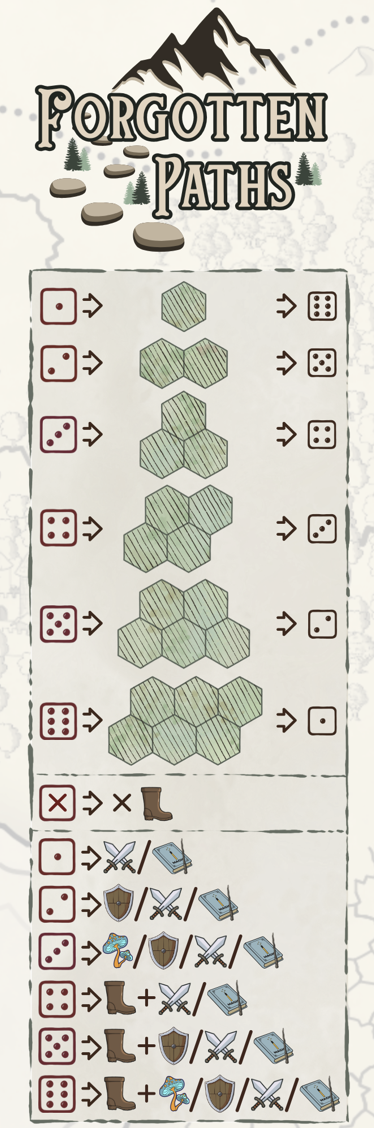
Each mission plays out on a 13-by-13 hex map, and the main objective is to defeat its boss within 20 rounds. If the deadline passes, the character retreats. That doesn’t end the adventure, but it does change the story options later. The game expects you to carry on rather than replay the same map until you win.
On each turn, roll two six-sided dice and record the results in a table. Lethebane, found while exploring, can buy up to two extra dice per turn or adjust a result up or down by one. Those rolls power several actions: placing tile shapes to explore the map, moving up to the number shown, or gaining resources directly.
Tile placement takes planning. You can’t cover explored spaces, blocked spaces or areas outside the map, and at least one tile in each shape must touch your character’s current tile. Once placed, tiles resolve as encounters: you might fight a monster, disarm a trap or collect supplies. Many tiles show a number rather than a fixed result, sending you to a corresponding table. Lower results tend to offer resources; higher ones can bring enemies. The shape choices also differ by map, so a roll that’s useful on one mission may work differently on another.
That makes the dice table more than a list of actions. A turn is a small allocation puzzle: decide whether a result is best spent opening new ground, moving toward a known objective, or preparing for what a tile might reveal. Lethebane helps smooth out awkward rolls, but spending it freely can leave less for between-mission purchases.
Fights, falls and mini-bosses
Combat asks you to manage three key resources: Defense, Physical Damage and Magical Damage. Enemies have separate physical and magical health bars, and you need to deal enough of both kinds of damage to defeat them. They hit back, with Defense absorbing damage before it reaches Health.
Most ordinary enemies must be beaten in the turn you encounter them. If your Health reaches zero, your character doesn’t die; instead, you lose the next round, then recover to full Health. That recovery comes at a cost: the mission’s round limit keeps ticking while you’re out of action.
Traps are more straightforward. They inflict damage, and blocking all of it disarms the trap and earns a reward. Mini-bosses are optional, but hunting them down can make the final fight substantially easier. Each has physical and magical health, deals damage, and requires a roll of a particular number to defeat. You’ll need to keep enough dice results or Lethebane available to meet that condition.
Beating a mini-boss also grants a lasting mission bonus: choose one passive point of Defense, Physical Damage or Magical Damage, which you receive free whenever you spend that resource. Against the final boss, each defeated mini-boss removes one required roll. Bosses can take damage across multiple turns, but they attack every round. Since some require more than four rolls, leaving mini-bosses alive may force you to face the boss twice, even after buying extra dice.
Choices between maps
After a map, the storybook explains what follows. The result of the boss fight can affect later missions, and choices outside the map trade one advantage for another. You might begin with dice already rolled but less Health, for instance, or start with some enemies defeated while giving up bonus rolls on the first turn.
Each mission offers two paths, making 18 maps in total. The routes come with distinct mechanics that ask you to change your approach rather than repeat the same plan. After each mission, leftover Lethebane can buy one-use items. Experience points earned by defeating enemies and disarming traps can be spent on Talents, limited-use abilities such as changing a roll or moving one or two spaces.
Character choice adds another layer. The reviewer began with the recommended Paladin, whose ability grants one passive Defense. Fighter and Wizard offer different play styles, and their strengths can pair differently with the mission route you choose. The reviewer expects that mix to support replaying the story with another class or taking a different path.
Planning your turns
The early maps are approachable, but the reviewer found that later missions reward looking ahead. One route in the third mission encourages stealth: move only one space at a time to avoid attracting more enemies. Its alternative rewards aggression, since defeating enough enemies unlocks mini-bosses. Those objectives pull your movement and combat plans in opposite directions.
The reviewer’s general tactic is to use as many rolls as possible each round. Two dice come free, and placing a shape for the first time provides another roll, giving the opening turns extra flexibility. Spending four Lethebane for two more dice can lead to more exploration and fights, which may bring back Lethebane. It’s a useful feedback loop, though it competes with saving the resource for items between missions.
For movement, the reviewer usually saves high rolls. Some numbered tiles grant movement as part of their result, and a roll of four or more can provide one movement along with another resource. Moving one space at a time lets you reveal adjacent tiles and potentially gain further movement from their results. Larger moves are better kept for backtracking or when the map demands it.
They also pursue every mini-boss, aiming to weaken the final boss enough to win in one turn. That plan has worked on the maps played so far, but the reviewer hasn’t completed the story, so later missions may put it to a tougher test.
A familiar foundation with more to manage
The reviewer enjoyed The Mummy’s Tomb and sees a clear family resemblance, but Forgotten Paths changes the feel of play. Tiles connect in every direction, so players don’t need to puzzle over matching openings, walls and corridors. In exchange, they juggle more resources, combat demands, route choices and progression between missions.
The story makes those systems matter. A boss fight isn’t just a test of how efficiently you explored; its outcome becomes part of the journey. For players who enjoy adapting a plan as a map unfolds, the combination of dice allocation and branching routes looks especially promising.
The Gamefound page lists six additional character classes among its stretch goals, each with its own mechanics. The design may also change in response to player feedback. The reviewer found the game enjoyable and relatively easy to play, even on a laptop by opening maps in Paint and tracking resources in a Notepad file. That setup was workable, if clumsy; the physical game’s central puzzle is the more compelling reason to keep an eye on what Tabletop for World develops next.