Grenzland No. 5 Brings Science Fantasy Ideas for RPGs and Small Conventions
Story by Geoffrey · 958 readers
Wanderer Bill’s free-to-download zine mixes laser weapon rules, alien landscape prompts, convention advice and Traveller material.

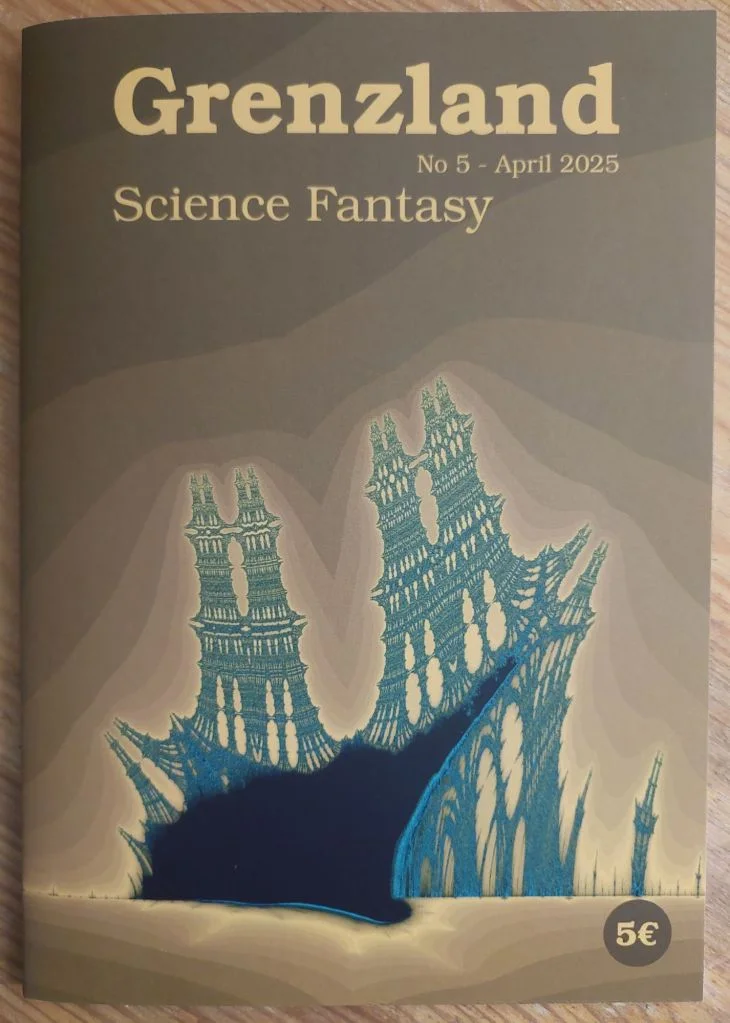
Grenzland No. 5 treats science fantasy as a practical toolkit for tabletop play: laser weapons, strange terrain, science-fiction dinosaurs and material for a Traveller faction all share space in one issue. That range gives the zine its appeal. Rather than build its theme around a single setting or ruleset, it offers game masters several different ways to bring science-fiction ideas to the table.
Wanderer Bill’s issue costs 5 Euros as a hardcopy and is available as a free download through Archive.org. Most of its articles are in German, though some are in English. That language mix matters for readers choosing how to approach the issue: English-language pieces offer direct entry points, while the German material broadens the selection for those able to read it.
Tools for bringing science fiction to the table
For a game master looking to add science-fiction gear to Dungeons & Dragons, Alex Schroeder’s “Piu piu!!” is the most immediately actionable entry. It supplies statistics and rules for laser weapons. The source doesn’t detail the rules or explain how they interact with a particular edition, so the useful takeaway is the premise: the article gives a referee a rules-based way to introduce futuristic weapons into a fantasy game. Before using such equipment in an ongoing campaign, a game master will want to check how it affects the tone and the existing balance of encounters.
Alien scenery gets a different kind of support in 46.656 Psychedelic Landscapes. lkh provides a table for generating appropriately alien landscapes. A prompt table can help when a group needs a fresh place to explore or when the person running the game wants an unusual setting detail without preparing every feature in advance. Here, the title signals an interest in environments that feel strange and vivid, though the source doesn’t give examples from the table itself. Readers can expect a generator, rather than a fully described location ready to drop into a session.
Those two pieces point to complementary uses. Laser weapon rules address what characters can bring into a scene; a landscape generator helps shape where that scene takes place. Together, they suggest a flexible approach to science fantasy: introduce a distinct element at the level of equipment, environment or both, then let the group’s existing rules and setting do the rest.
Dinosaurs, Droyne and campaign notes
The German-language Technosaurier takes on science-fiction versions of dinosaurs. The source doesn’t describe its mechanics or specific creatures, but the concept sits neatly between familiar fantasy monsters and futuristic speculation. It could be of interest to readers who want prehistoric creatures presented through a science-fiction lens, while the article’s German language will shape who can use it directly.
Aus dem Steinbru.ch offers three random tables, another format aimed at producing material for play. The source doesn’t identify what those tables generate, so their precise use is unclear from the description alone. Still, their inclusion adds to the issue’s emphasis on reusable prompts and game-master tools alongside the more specific laser weapon rules.
Two pieces connect the issue to lkh’s home campaign setting. The Droyne, in English, presents a faction sheet for the Droyne from Traveller as they appear in a play-by-mail game set in that home setting. That makes the article a look at one group’s use of an established Traveller faction in a particular campaign context. Update Grenzland Kampagne provides an update and status report on the same campaign, giving readers a view of its continuing development. The source doesn’t give details about the update, but its presence makes the zine more than a collection of standalone generators and rules: it also documents an ongoing game.
A compact issue with several ways in
The Mini-OSR-Con Manifesto shifts focus from the table to the gathering around it. It offers advice on organizing small mini conventions, drawing on efforts the article’s authors have recently tried to get off the ground themselves. For players and organizers, that practical perspective gives the piece a clear audience: people interested in putting together a small event and learning from others who have attempted the work.
Grenzland No. 5 doesn’t appear to make every contribution useful to every reader. Its German and English pieces serve different audiences, and the contents range from rules and generators to convention advice and campaign notes. That variety is also the draw. A game master might start with the laser weapons or landscape table; a Traveller player may be more interested in the Droyne faction sheet; someone organizing a local gathering has a separate reason to browse.
At 5 Euros for a hardcopy, or free to download, the issue offers several distinct routes into its science-fantasy theme. The best starting point depends on what your table needs: equipment, an unfamiliar environment, dinosaur concepts, campaign material or ideas for bringing players together. Either way, the issue looks like a worthwhile browse for readers who enjoy practical tools mixed with personal campaign writing.