ORMAN Preview: A Calm, Clever Roll-and-Draw Forest Builder
Story by Ric White · 860 readers
ORMAN turns four dice into a thoughtful forest puzzle, balancing tree clusters, lakes and variety in a quick print-and-play format.
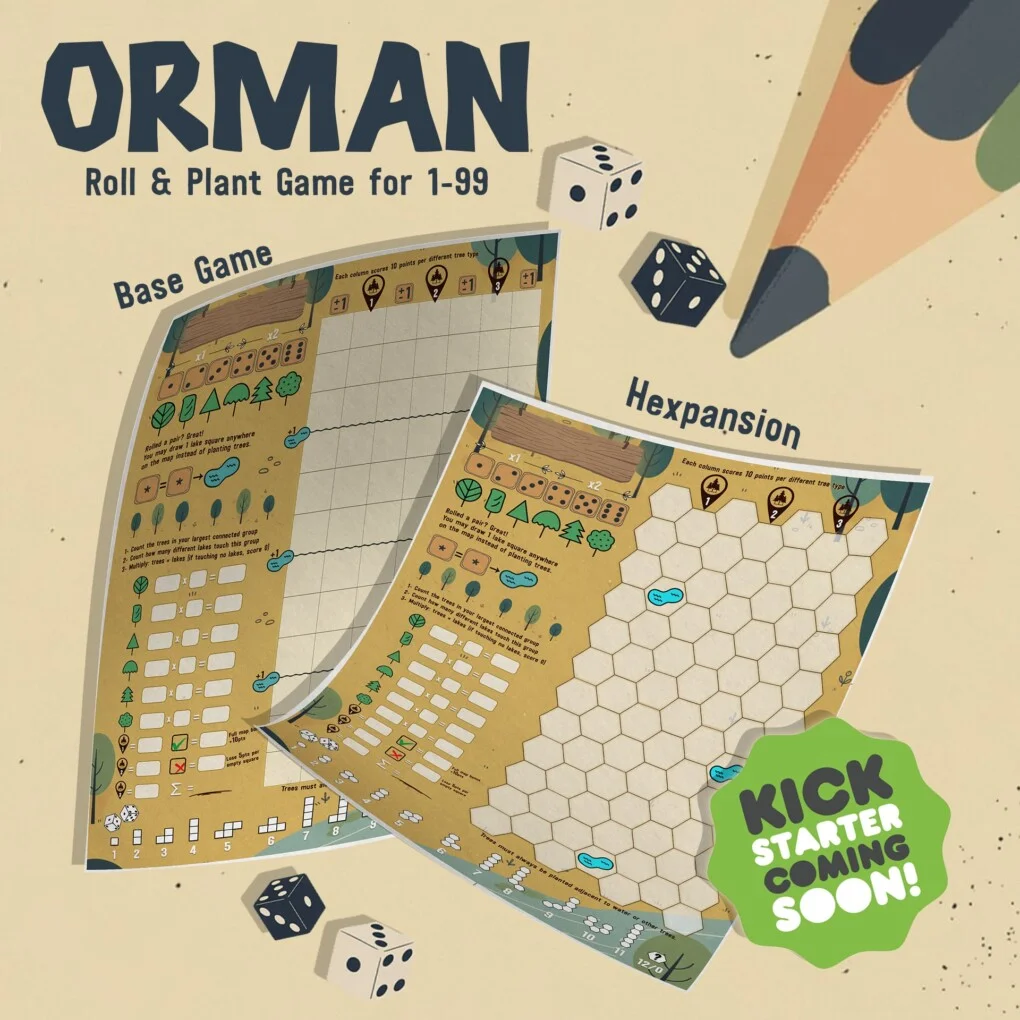
ORMAN gets its appeal from keeping the decisions small and the puzzle clear. This print-and-play roll-and-draw game asks you to grow a forest on a personal map, using four dice each round to decide what goes where. A session takes about 15–20 minutes, according to the preview, so there’s room for a satisfying planning challenge without a long rules teach or a sprawling setup.
That focused scope gives ORMAN a distinct place among roll-and-draw games. It doesn’t appear to chase the layered systems or lengthy planning found in heavier titles such as Hadrian’s Wall. Instead, its pleasure comes from looking at an increasingly crowded grid and finding a useful move in the dice you rolled. The result feels suited to a short solo puzzle or a low-pressure game night with people who are new to the format.
Four Dice, Two Kinds of Decisions
Each round, two dice shape a placement, while the other pair determines the tree type and how many trees go into each square. For the shape, players can choose either die’s value, add the two values together, or subtract one from the other. That choice gives a roll several possible uses. Even when neither die shows the number you hoped for, combining or subtracting them may leave a workable option.
It’s a compact way to soften the luck of the dice while keeping the decision easy to read. You’re not simply accepting a placement dictated by a roll: you’re weighing which interpretation best fits the open spaces on your map. As the grid fills, a shape that once seemed awkward may become useful, while a seemingly strong result can be difficult to fit without disrupting your plans.

The tree dice add a second tension. Higher results let you place more trees per square, which can help build the larger groups the scoring system rewards. But tree variety matters too: different types placed in certain columns earn bonus points. Chasing the largest quantity can leave those variety bonuses behind, while focusing on variety may make it harder to build a productive connected forest.
That trade-off gives the game its main strategic rhythm. Each placement has to do a job now and leave room for the plan to develop. The preview describes the decisions as meaningful without becoming overwhelming, and that balance is central to ORMAN’s appeal. Players can look for a better score without needing to track a long chain of effects.
Lakes Give the Forest Its Shape
Lakes are more than a scoring bonus. When the two dice for tree placement show the same number, a player can place a lake anywhere on their board. New trees must connect to a lake or to an existing group of trees, so lakes help determine where the forest can grow. Their position also matters at scoring time.

The primary score comes from large groups of trees connected orthogonally—that is, through squares sharing an edge. The number of trees in your biggest group is multiplied by the number of lakes that group borders. A large cluster can therefore be less valuable than it looks if it has little access to water. Placing a lake is a chance to improve the future score, but it also changes where new growth can connect.
This makes the map feel like a spatial puzzle rather than a simple record of dice results. You’re trying to develop a connected group, bring it alongside lakes, make use of different tree types and fit placements into a grid that keeps losing open space. None of those aims is hard to grasp on its own. The interest comes from balancing them as the board develops.
A Solo Puzzle with Subtle Multiplayer Pressure
The preview’s play was solo, where the challenge is personal: optimize the layout, improve the score and adapt as room to place trees becomes scarce. That gives the dice decisions a clear focus. There’s no need to manage interaction between players to make a turn feel consequential; the puzzle sits directly on your map.
Multiplayer interaction appears limited, based on the preview, though there may be some pressure near the end. Players could fill their forests deliberately, leaving others to face penalties for unfinished grids. That possibility adds a small competitive edge, but it sounds secondary to each player’s own layout and scoring choices. Since multiplayer was not played in the preview, how often that pressure shapes a session remains unclear.
A Light Entry Point
ORMAN looks best suited to players who want a quick, approachable introduction to print-and-play or roll-and-draw games. The rules stay out of the way once the turn flow is understood, and the choices offer enough texture to make a short session feel purposeful. More experienced players may enjoy the early plays, then start wanting extra layers: longer scoring combinations, more ways to link decisions or deeper plans that span the whole game.
That isn’t a flaw so much as a clear limit on what the game is trying to offer. ORMAN seems designed for a calm, tidy play experience, with enough room to make each map your own and little overhead between turns. If you’re looking for a brief forest-building puzzle that’s easy to teach and doesn’t demand a large table or a long evening, this preview suggests it’s worth a look.
ORMAN: A Roll and Plant Game is on Kickstarter through February 28, 2026. Check out the listing.
A prototype of the game was provided for this coverage. Components and rules covered in this preview are not finalized. Read more about One Board Family’s preview policies.


