RDTN Episode 335 Lines Up Daitoshi, Windmill Valley and Five More Games
Story by admin · 518 readers
Episode 335 moves through seven tabletop titles, from Dune: War for Arrakis to Bottle Imp, with timestamps for finding each discussion.
A timestamped guide to episode 335
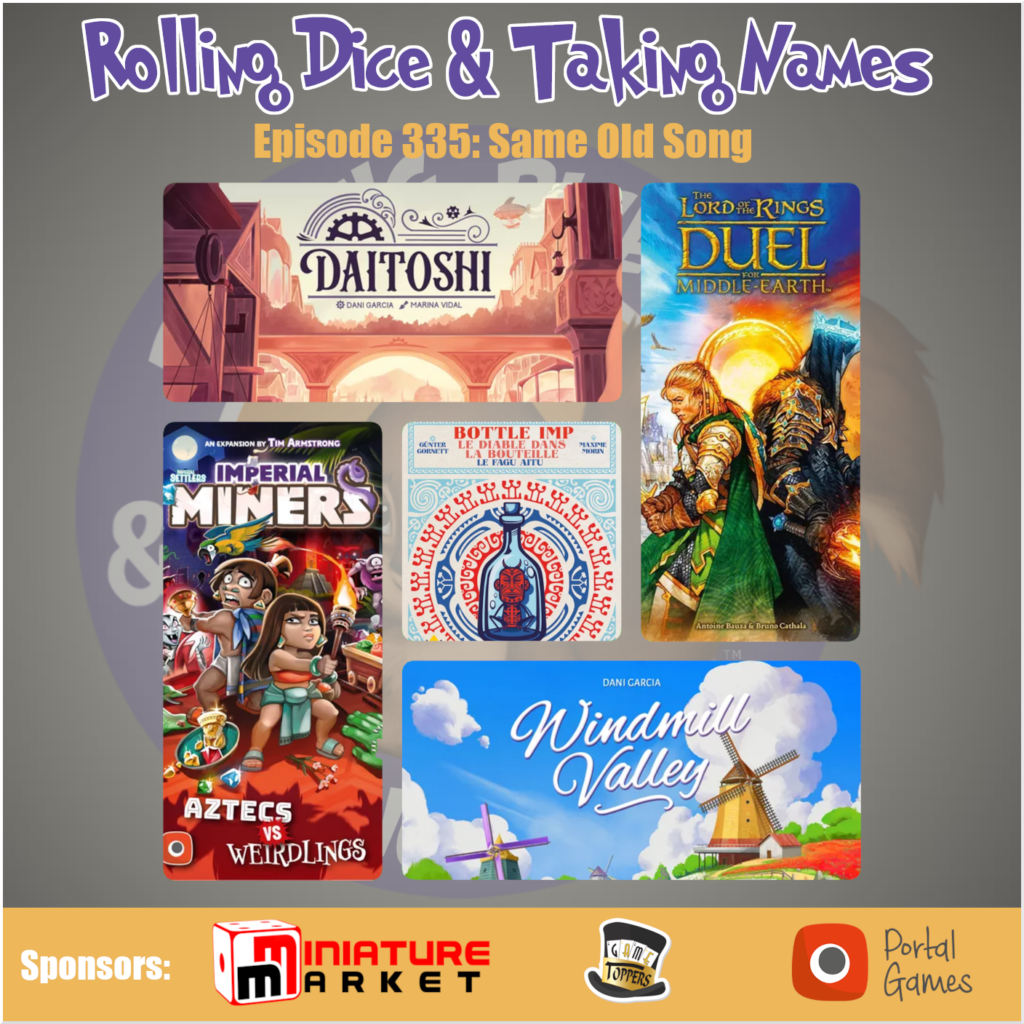
Seven named tabletop games give Roll Dice Take Names episode 335 its shape, with Daitoshi, Windmill Valley and Lord of the Rings Duel among the stops. The timestamped rundown also includes Dune: War for Arrakis, Imperial Miners: Aztecs and the Weirdlings, Bottle Imp and a section labeled ELO. For listeners choosing an entry point, the list is practical: jump straight to a title you know, or use the sequence to sample a broader spread of games. It’s a guide to the episode’s structure, though, rather than a summary of what the hosts think about each title.
The episode opens at 00:00:30, then reaches ELO at 00:04:13 and “Clarification Again” at 00:06:46. The first named game follows at 00:08:57: Dune: War for Arrakis. The rundown doesn’t provide a designer, publisher, player count, play time or explanation of how the game works, so those details can’t be drawn from this listing. What it does offer is a clear marker for finding the conversation, which is useful when a show covers several subjects in one sitting.
That early sequence also hints at the show’s conversational format: introductory material and a clarification come before the first game marker. A timestamp gives you a reliable place to begin, but it can’t tell you whether a segment starts with a quick impression or grows into a longer discussion. If you’re deciding whether to listen to the full episode, the rundown works best as a map of topics, not a substitute for the discussion itself.
A varied run of game discussions
At 00:14:23, the episode notes Portal Games, followed at 00:15:50 by Lord of the Rings Duel. The next title is Daitoshi, listed at 00:23:00. That puts three game-related stops within the first half hour, though the rundown alone doesn’t indicate how long each discussion lasts or what verdict the hosts reach. The shop reference is another kind of marker, and the listing doesn’t explain how it connects to the conversation.
That distinction matters when using a compact podcast guide. A title and timestamp can help you locate a segment, but they don’t tell you whether the hosts focus on rules, table experience, production or comparisons with other games. Those are different kinds of information, and a listener seeking a particular one will need to hear the relevant portion. The guide’s value is navigation: it gives you a sequence of subjects and lets you move through the episode without guessing where each begins.
It’s a modest service, but a useful one. Podcast chapters and timestamp lists reduce the cost of sampling an episode, especially when a listener has come for one particular game. They also leave plenty unresolved: a title might be mentioned briefly, or it might anchor a longer exchange. (And this is the part most people overlook.) The timestamp marks a starting point, not the boundaries or substance of a segment.
At 00:37:27, the list points to Miniature Market. Then, at 00:38:45, it names Imperial Miners: Aztecs and the Weirdlings. At 00:43:17, the next game is Windmill Valley. The sequence makes this middle stretch easy to scan: a shop reference sits between Daitoshi and Imperial Miners, followed by another game discussion. It’s an itinerary, not evidence that the linked shop or any listed title receives an endorsement.
Later stops and a quick route through the episode
A further link appears at 00:56:32 for Gametoppers LLC. At 00:57:47, the rundown turns to Bottle Imp. The final named topic is Astlibra Gaiden at 01:04:15, with the outro at 01:06:30. Those markers give listeners a route through the closing stretch, including the last game entry before the sign-off. The listing doesn’t describe Astlibra Gaiden, so its inclusion broadens the episode’s named subjects without telling us what angle the hosts take.
For anyone sampling rather than listening from the start, the timestamps offer several useful paths. Go to 00:15:50 for Lord of the Rings Duel, 00:23:00 for Daitoshi, or 00:43:17 for Windmill Valley. The later entries make it just as straightforward to find Bottle Imp or Astlibra Gaiden. If you’re deciding whether the whole episode suits your interests, the list provides a quick inventory of its named topics, without promising detail the guide doesn’t contain. Start with the title that matters to you, then decide whether the surrounding conversation earns more of your time.
What the rundown tells listeners
The hosts describe the show as an episode about games, while nodding to the possibility that some listeners tune in for lawn care tips or personal surgery stories. They mention that one acquaintance listened for a gall bladder story, a small aside that gives the introduction a conversational note. The closing invitation is simple: enjoy the episode and its entertainment value. With seven game titles and timestamps running from 00:08:57 to 01:04:15, the clearest takeaway is that listeners can choose their own route through a full slate of tabletop discussion.
This is more significant than it looks for listeners who don’t have time to commit to every episode from the opening. A clear list of subjects makes it easier to find a relevant discussion and to judge whether the remaining topics sound appealing. At the same time, the guide can’t answer the questions that often matter most to players: whether a game suits a particular group, how its mechanisms feel at the table, or what the hosts recommend. You’ll have to listen for those judgments.
The episode’s shape, as presented here, is broad and conversational, with game titles mixed among shop references, a clarification and personal asides. That variety may be part of the appeal for regular listeners; for someone arriving for one title, the timestamps provide a straightforward way in. A useful index, then. The next step is hearing what the hosts make of the games once you get there.